


Valeda Treatment: A Breakthrough in Managing Dry Macular Degeneration
Valeda Treatment: A Breakthrough in Managing Dry Macular Degeneration
Dry age-related macular degeneration (AMD) affects millions of people worldwide, often leading to gradual central vision loss that impacts daily life. Until recently, treatment options were limited, focusing mainly on lifestyle changes and nutritional supplements. But a new, non-invasive therapy—Valeda Light Delivery System—offers promising hope for those living with dry AMD.
What Is Dry Age-Related Macular Degeneration?
Dry AMD is a chronic eye disease caused by the thinning of the macula, the central portion of the retina responsible for sharp, central vision. It’s the more common form of AMD, accounting for about 85–90% of all cases. It typically progresses slowly, but over time, it can severely impact the ability to read, recognise faces, and perform everyday tasks.
Introducing Valeda: Light-Based Therapy for the Eyes
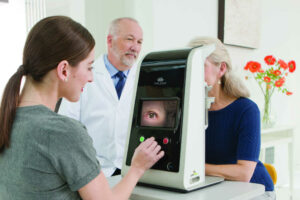
The Valeda Light Delivery System, developed by LumiThera, uses photobiomodulation (PBM)—a form of light therapy that stimulates cellular function. PBM has been used in other areas of medicine for decades, but Valeda is the first approved device specifically designed to target ocular cells in patients with dry AMD.
How Does Valeda Work?
Valeda delivers multiple wavelengths of light—blue (590 nm), red (660 nm), and near-infrared (850 nm)—in a controlled manner to the retina. These wavelengths are believed to:
· Enhance mitochondrial (energy cells) function in retinal cells
· Reduce oxidative stress and inflammation
· Improve blood flow to the retina
· Promote cellular repair and reduce cell death
· The therapy is typically administered in a series of short, painless sessions.
What the Research Says
Clinical trials, including the LIGHTSITE studies, have shown that Valeda treatment can:
· Improve visual acuity in some patients
· Slow the progression of dry AMD
· Enhance contrast sensitivity and quality of life
· While it is not a cure, Valeda offers a significant step forward in managing the disease and it does so without drugs, injections, or surgery. Which makes it a non-invasive and non-traumatic experience.
Who Is a Good Candidate?
Valeda is currently intended for use in patients with early to intermediate dry AMD who still retain some central vision. It is not very effective for late-stage dry AMD (also called geographic atrophy).
It is generally not advised in wet AMD cases, which involves abnormal blood vessel growth. Wet AMD is better treated with Anti-VEGF treatment instead.
Our Optometrists will assess your condition and determine if Valeda is a suitable option.
What to Expect from Treatment
Duration:
Sessions last ~ around 6 minutes per eye
Frequency:
Typically 3 times per week every 4 months
Side effects:
Minimal to none reported; no pain or discomfort during treatment. A possible colour splodge in the vision for a few minutes after treatment.
Results:
Some patients report noticeable improvements in vision clarity, though outcomes vary. The treatment is for slowing down the progression of AMD. It is not a cure.
Looking Ahead
While Valeda is not yet universally, it represents an exciting advancement in dry AMD care. As more clinical data emerges and accessibility improves, photobiomodulation could become a mainstream option for vision preservation.
Final Thoughts
If you or a loved one is managing dry AMD, ask your Optometrist about Valeda. As with any therapy, individual results will vary, but light-based treatments may soon become a powerful tool in our arsenal against age-related vision loss.